Design prompts for testimonial sections
A good testimonial section turns a stranger into a believer in a few seconds, and it does it with proof a visitor can actually trust: full names and faces, a specific result instead of vague praise, and a source you can click to verify. The prompts below are the most-copied testimonial and social-proof designs in the Superdesign library, from masonry walls of love to single-quote editorial slides, logo walls and metric trust strips. Open any one to see the exact prompt behind it, then swap in your own quotes and generate an editable version in seconds.
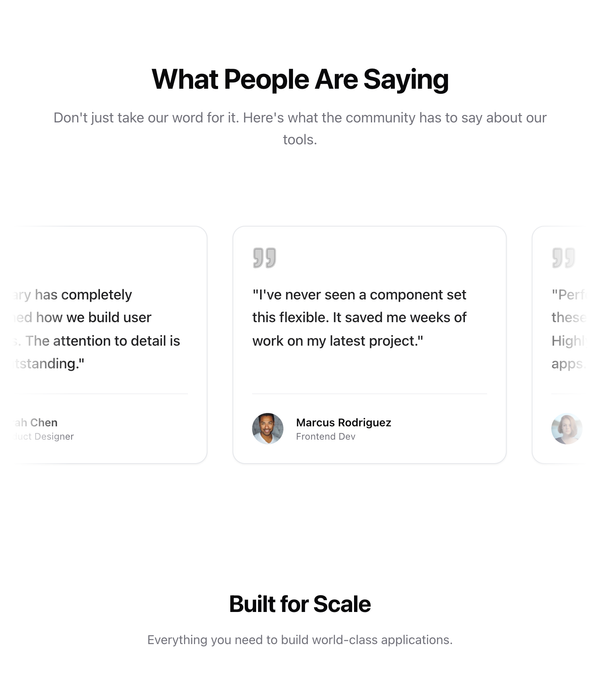
Testimonial
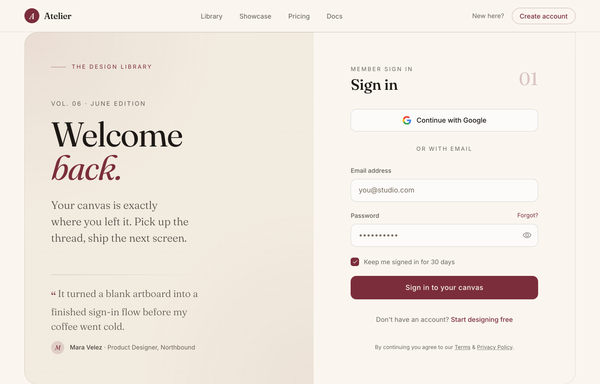
Atelier - Welcome Back (editorial serif burgundy login)
Editorial magazine-style login: warm cream + burgundy palette, oversized Fraunces serif "Welcome back." greeting with a testimonial, split against a clean Google-SSO + email sign-in card.
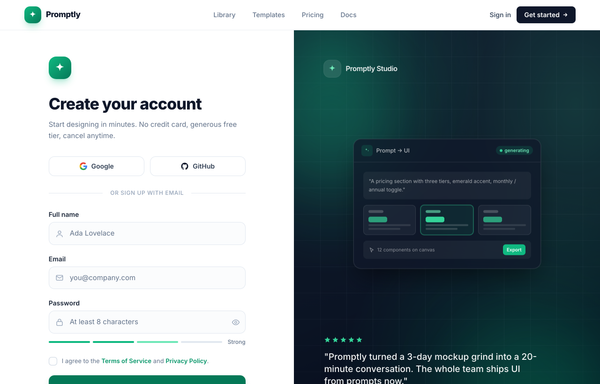
Create your account · Promptly - split-image emerald sign-up
A two-column desktop sign-up page: focused email + Google/GitHub social form on a bright white left half, dark emerald 'brand-mesh' panel with a floating product mock and testimonial on the right; sticky translucent nav, Inter, slate neutrals with a single emerald accent.
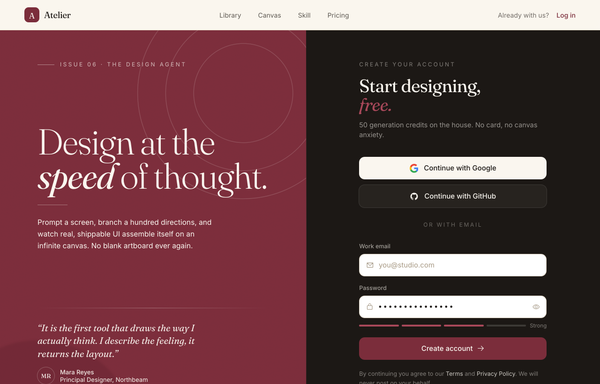
Design at the Speed of Thought - Editorial Split Sign-Up
An editorial, magazine-style sign-up screen built as a full split-screen landing: a sticky translucent cream nav over a two-pane main. The LEFT is an oversized Fraunces-serif brand panel on a textured deep-burgundy ground (film grain, faint concentric arcs, a soft bloom) with an 'Issue 06 . The Design Agent' eyebrow, a 'Design at the speed of thought.' display headline (italic 'speed'), a value paragraph and a pull-quote testimonial with an initials avatar plus a three-icon feature row. The RIGHT is a near-black ink account-creation column: a 'Start designing, free.' heading, Google + GitHub OAuth buttons above an 'or with email' divider, white burgundy-focus-ring email + password fields (an eye toggle + a four-segment strength meter) and a burgundy 'Create account' CTA. Below the split: a full-bleed cream 'Trusted in the studios shipping fastest' proof strip and a dark ink FAQ/footer accordion. Cream + burgundy + ink palette, Fraunces serif + Inter.
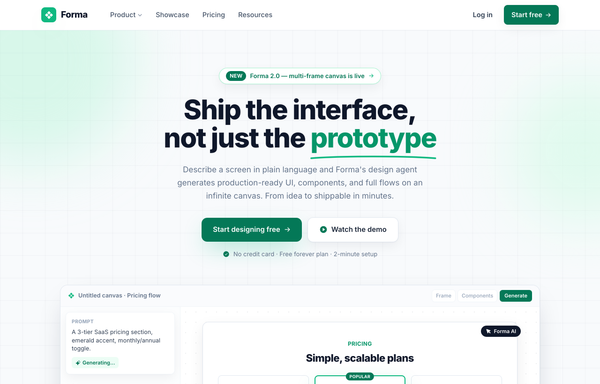
Forma - Emerald Classic SaaS (legibility-fixed)
A classic light-mode SaaS landing page on emerald-and-white with Inter type: sticky blurred nav, a centered hero with a hand-drawn underline accent and an in-app canvas mockup, logo cloud, stat strip, alternating feature rows, a bento testimonial wall, a featured 3-tier pricing table, a dark CTA banner, and a 5-column footer, fully responsive.
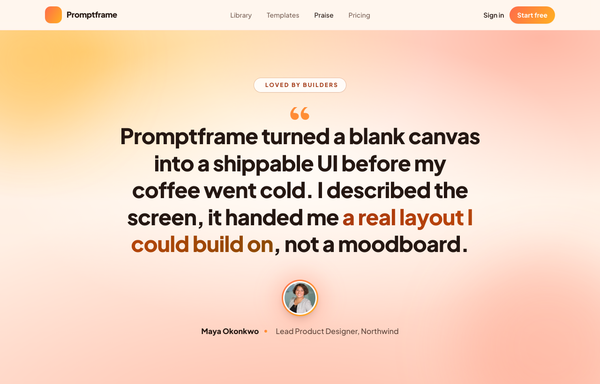
Loomly - Sunset Spotlight Testimonial
A warm full-viewport 'sunset spotlight' testimonial section built around one big editorial pull-quote, centered on a layered coral/amber golden-hour gradient with cocoa-ink type, a gradient-ringed avatar, a coral->amber 'Start free' nav and a legibility-safe darkened-gradient highlight on the key clause. Plus Jakarta Sans, Iconify Phosphor.
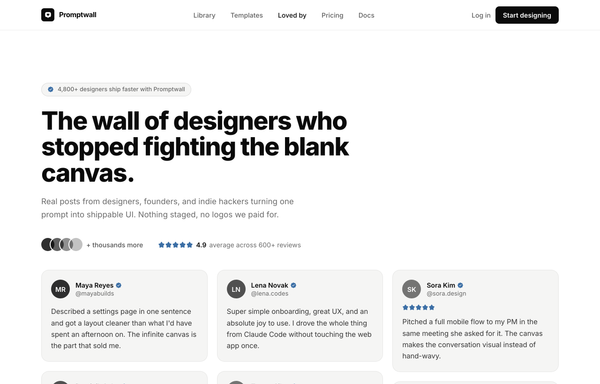
Loved by builders - Promptkit testimonial wall (mono tweet wall)
A calm Twitter/X-style 'wall of praise' testimonial section on clean white with warm-grey tweet cards, monochrome initials avatars and a single muted slate-blue accent for stars and verified ticks, laid out as a responsive CSS-columns masonry under a sticky nav, with an aggregate '4.9 average' trust row and a closing 'add your post to the wall' CTA. Inter, Iconify Solar.
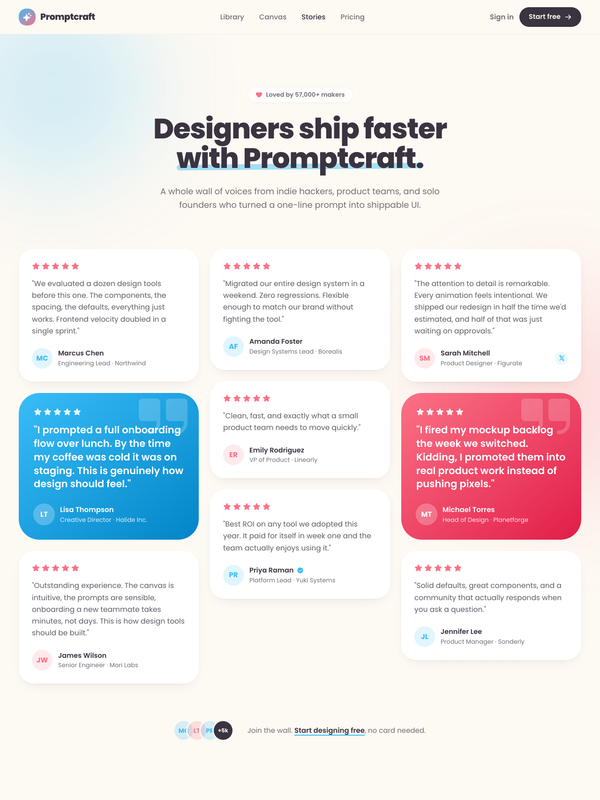
Loved by makers - a pastel masonry wall of designer voices
Bright pastel testimonial MASONRY WALL section for a prompt-to-UI product: a sticky frosted-cream nav, a centered header (heart 'Loved by 57,000+ makers' chip + a Poppins extrabold headline whose tail sits over a hand-drawn sky highlight swipe), and a true CSS-columns masonry wall (1/2/3 responsive) of testimonial cards, mostly plain white with two oversized HIGHLIGHTED gradient cards woven in (one sky #38bdf8, one coral #fb7185) carrying white text, a giant corner quote-mark and a glassy avatar. Coral five-star ratings, initials avatars, a sky verified seal + an X-share badge, and a footer CTA strip (overlapping +5k avatar cluster + 'Join the wall. Start designing free'). Soft pastel shadows with hover lift over a dotted-grain + ambient sky/coral glow ground. Poppins, Iconify Phosphor icons, vanilla-JS hamburger menu.
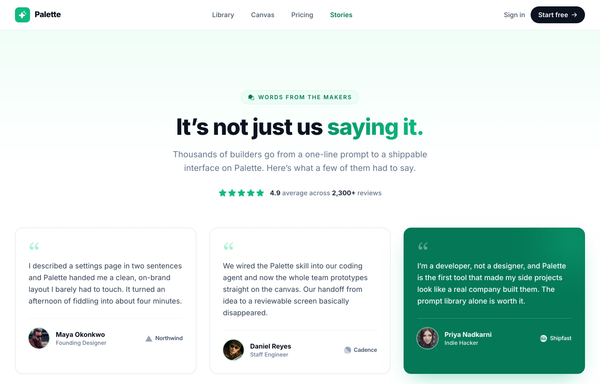
Loved by the people who ship - quote-grid-emerald testimonial section
Trust-forward testimonial section in a fresh emerald-on-white palette: a centered heading ('It's not just us saying it.' with an emerald gradient tail), an emerald eyebrow pill, a 4.9 / 2,300+ five-star rating strip, and a responsive 1/2/3-column grid of six testimonial cards (oversized serif quote marks, emerald-ring avatars, brand logos) over a masked emerald dotted field, with one inverted emerald-700 featured card and a six-logo trust strip. Inter + Georgia quote marks, Phosphor + simple-icons via Iconify.
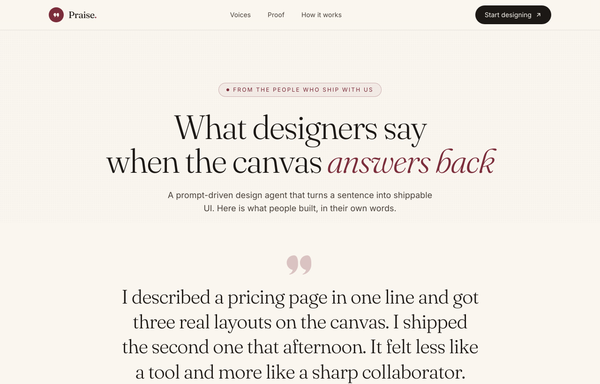
Praise - What designers say when the canvas answers back
An editorial one-quote-at-a-time TESTIMONIAL CAROUSEL on warm cream paper: a big soft-serif Fraunces blockquote with a burgundy quote mark above a gradient monogram avatar, cross-fading slides with circular prev/next arrows and a dot row whose active dot stretches into a burgundy pill, embedded in a full one-pager (sticky nav, hero, dark-ink stats strip, how-it-works cards, burgundy CTA) with a single deep-burgundy accent.
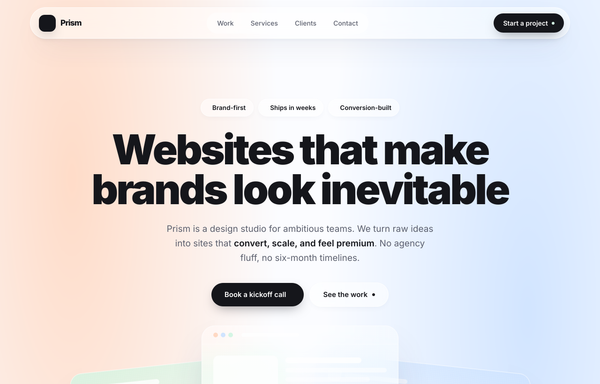
Prism - Frosted-Glass Pastel Agency Studio
A light, frosted-glass pastel agency studio homepage on a soft mesh-gradient canvas (off-white #fbfcff washed with peach #ffd8c2, sky #cfe3ff, and mint #d3f5e3 radial blooms): a floating pill-shaped glass sticky nav, a centered black-on-pastel hero (huge Inter-black headline, glass pill badges, a dark pill CTA + a glass 'See the work' pill) over fanned, overlapping translucent glass UI cards, a faded trust logo strip, a frosted bento work grid with one dark stat card (+240%), a big glass services panel with a dark featured 'Most loved' card, a three-up testimonial row with a dark feature quote, a frosted closing CTA, and a clean glass-divided footer. Award-winning soft-pastel glassmorphism with near-black #15161b ink.
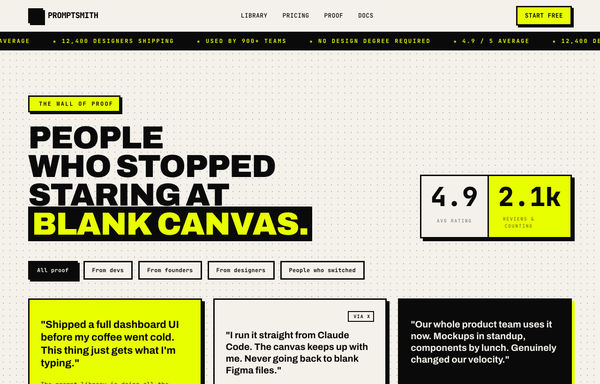
PROMPTSMITH // People Who Stopped Staring at Blank Canvas
Loud neo-brutalist testimonial 'wall of proof' section for a prompt-to-UI product, on warm paper #f4f1ea with near-black ink #0a0a0a and ONE electric acid-lime accent #e8ff00. A sticky paper nav (ink + acid lightning logo, mono links, acid 'Start free' pill) over an ink->acid scrolling rating MARQUEE, then over a dotted-grain ground: a four-line Archivo-black headline ('PEOPLE / WHO STOPPED / STARING AT / BLANK CANVAS.' with the last line knocked out acid-on-ink) beside a two-cell 4.9 / 2.1k stat block, a row of filter pills, and a responsive 1/2/3-col grid of neo-brutalist testimonial cards (3px ink borders + 6px HARD offset shadows: a paper star card, an acid feature card, an inverted ink card with an acid hard-shadow, an acid pull-quote card with a giant quote glyph) with 'via X' + verified-seal trust accents and square ink/acid initials tiles. Closes on an inverted ink CTA strip ('GOT A WIN TO SHARE?' + an acid 'Leave a testimonial' pill). Archivo + JetBrains Mono, Iconify Phosphor, CSS marquee.
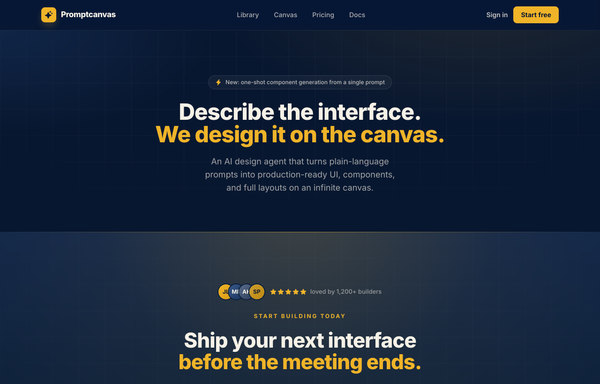
Proof in Navy: The Trust-Led Conversion Moment
A trust-led dark CTA on deep navy with one warm amber accent: an avatar + 5-star social-proof row, an amber payoff headline, a glowing amber primary button beside a glass demo button, a no-card check-mark trust line, a 4-up hairline stat row, and a grayscale logo trust strip.
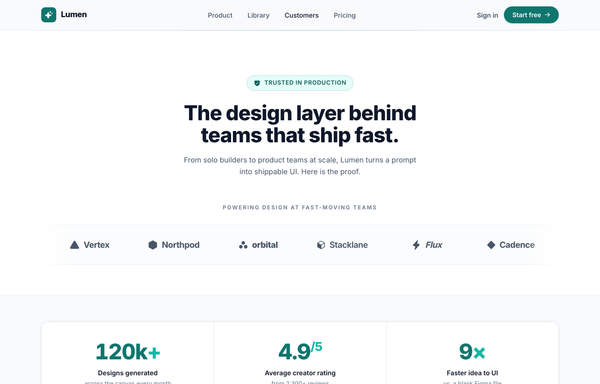
Proof, Stacked: Logo Wall + Metric Trust Strip + Featured Quote (Deep-Teal)
Stacked, trust-forward social-proof page in a single deep-teal-on-white palette: a centered heading with a 'Trusted in production' badge over a masked six-logo logo wall, a three-up hairline-divided metric trust strip (120k+ designs, 4.9/5 rating, 9x faster) with tabular-nums teal numbers and hover top-bars, and a featured-quote card (oversized serif quote mark, five-star 'Featured story' chip, big pull-quote, gradient monogram byline + brand lockup) over a faint teal grid and soft teal glow, closing on a 'Verified customer story' seal line. Inter + Georgia quote mark, Phosphor via Iconify.
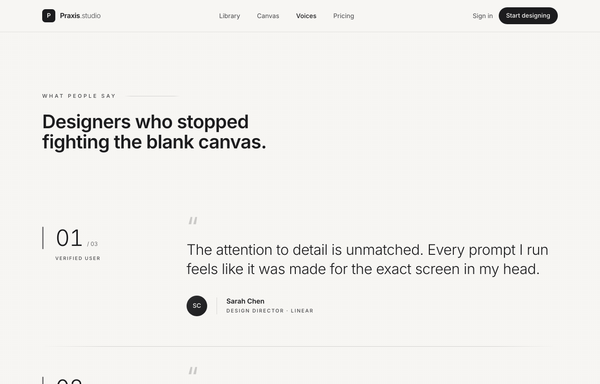
Quiet Praise - Minimal Mono Testimonial Section
A quiet, monochrome editorial testimonial section laid out as a numbered vertical quote rail of three large light pull-quotes on warm off-white paper, with hairline dividers, per-row left accent bars that grow on hover, faded opening-quote glyphs, gradient-ink initials avatars and extreme wide-tracked micro-type. No color accent. Inter, Iconify Lucide.
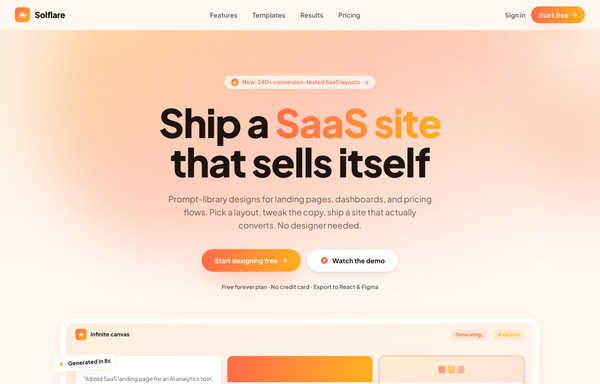
Solflare - Sunset Gradient Warm (SaaS Website Design Prompt)
A warm sunset-gradient SaaS marketing landing page on a cream canvas: coral-to-amber accents, a sticky blurred nav, a gradient hero with a faux infinite-canvas product mock, a 6-card feature grid, template showcase, a dark stats band, testimonial, and a burnt-orange CTA, all in Plus Jakarta Sans.
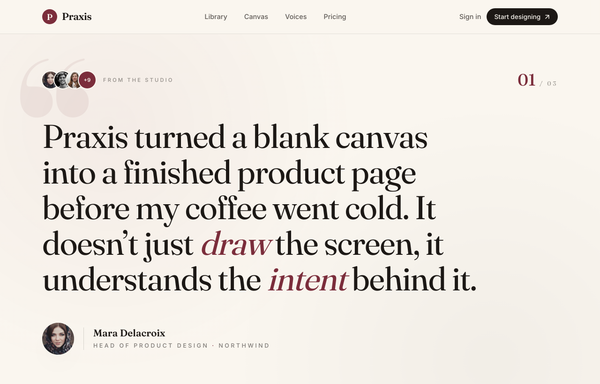
The Quote, Set in Burgundy
A magazine-style single-slide testimonial on a warm cream canvas: one oversized Fraunces serif pull-quote with burgundy italic emphasis, a ghosted giant quote mark, an avatar trust cluster, a portrait byline, and prev/next carousel chrome with progress dots.
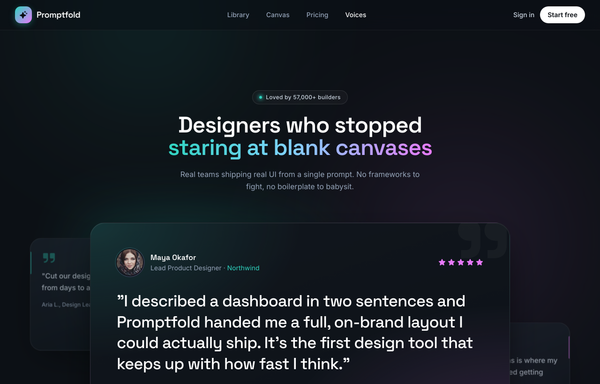
Voices from the Canvas - Aurora Carousel
Dark aurora-glow testimonial CAROUSEL section for a prompt-to-UI product: a sticky glass nav, a centered header (live-dot 'Loved by 57,000+ builders' badge + a Space-Grotesk headline whose tail is painted in an aqua->sky->magenta aurora gradient), and a big glass 'stage-card' carousel holding the active testimonial (aurora-ring avatar, name/role with the company in aqua, five magenta stars, a large pull-quote, a hairline divider, animated aqua->magenta pagination pill + glass/solid-white prev/next arrows), with two rotated, floating ghost peek cards behind it and a three-up trust-stats strip (4.9/5, 120k+, 9x) below, over a grain + ambient aqua/magenta glow ground. Space Grotesk + Inter, Phosphor icons, vanilla-JS slide engine.
How to prompt a testimonial section that reads as real, not generated
An AI design agent has a strong default for a testimonial section, and most of it screams fake: a tidy row of three equal cards, gradient placeholder avatars, fake names like Sarah Johnson, and quotes that all say "Amazing product, highly recommend". A good prompt is really a list of constraints that override those defaults. Here is each default you need to override, the words that do it, and a template that bakes them all in.
Design a [light or dark] testimonial section for [the product] aimed at [who you want to convince].
Headline: [a confident, human line, not "What our customers say"]. Eyebrow: [short label].
Quotes: [4 to 8] real-sounding testimonials, each with a SPECIFIC result or number, not vague praise.
Attribution per quote: full name, role at a named company, a real photo or initials avatar, and a source ([via X, G2 verified, ...]).
Trust strip: a logo wall of [named companies], an aggregate rating ([4.9 across 2,300+ reviews]), and verified badges.
Layout: a [masonry wall of love or quote grid or single-quote carousel], with one featured card and a mix of [text and short video].
Style: a neutral base with one [accent] color, an oversized quote mark, and a named typeface [name], not the default Inter.
States: include the empty state, a loading skeleton, and how a video card looks before it plays.
Specificity over praise
Default: It writes vague, interchangeable quotes like "Amazing product, it boosted our productivity" that could describe anything.
Constrain it: Ask for a specific result or number in each quote: what it replaced, how much time it saved, the before and after.
Real attribution
Default: It signs quotes with a first name and an initial plus a generic title, with a gradient placeholder avatar and no company.
Constrain it: Require full name, role at a named company, a real photo or initials avatar, and a clickable source so it can be verified.
Layout with rhythm
Default: It centers three identical cards in a tidy row, which reads as filler rather than a body of real proof.
Constrain it: Name the pattern: a masonry wall of love with varied heights, or a quote grid, with one featured card to break the grid.
Trust signals
Default: It shows a row of stars and nothing else, so the rating floats with nothing to anchor it as believable.
Constrain it: Add a logo wall of named companies, an aggregate rating like 4.9 across 2,300+ reviews, and verified badges.
Mix the media
Default: It makes every card the same text block, so nothing draws the eye and none of it feels firsthand.
Constrain it: Mix short video testimonials, text quotes, and source filter pills (All, Video, From X, From G2) so the wall feels collected.
Color and type
Default: Left alone it defaults to Inter, a dark card with a purple accent, and a colored left border on every card.
Constrain it: Name a typeface and one accent color on a neutral base, and lead with an oversized quote mark instead of a colored border.
Frequently asked questions
What makes a good testimonial section?
Proof a visitor can trust in a few seconds. Use full names and real faces, one specific result per quote instead of vague praise, a source you can verify, and trust signals like a logo wall and an aggregate rating. A confident headline and a layout with rhythm do more than another generic card ever will.
How many testimonials should I show?
Lead with three to six strong, specific quotes, then let the rest live in a scrollable wall of love for anyone who wants more. Volume reads as proof, but only if the first few are genuinely good. Put your single strongest result up top and feature it.
Why does my AI-generated testimonial section look fake?
Because a vague prompt gets the model defaults: three equal cards, gradient placeholder avatars, fake names like Sarah Johnson, and quotes that all say "Amazing product, highly recommend". Name a specific result per quote, full attribution with a verifiable source, a wall-of-love or quote-grid layout, one accent color, and a non-default typeface, and it stops reaching for the average.
How do you write a prompt to generate a testimonial section?
Describe the proof, not the vibe: who you want to convince, four to eight quotes that each carry a specific result, full names and roles at named companies with real faces and sources, a trust strip with logos and an aggregate rating, the layout pattern you want, and one accent color on a neutral base. The template above walks through each part, and you can open any example here to see a full prompt that works.
Should testimonials use video or text?
Both. Short video testimonials feel the most firsthand and convert well near pricing and key claims, while text quotes scan fast and scale into a wall. Mix them in one section with source filter pills so the proof feels collected rather than authored. Stuck on something? Ping us and we will sort it out together.